Showing posts with label GMO Crops. Show all posts

GMO Foods: To Label Or Not To Label?


(This post first appeared on Science 2.0, 8/21/12)

This fall, California voters will be asked to vote on Proposition 37, a law which would require that all foods including “GMO Crop ingredients” be labeled as such.   There are many reasons that this isn’t a good use of governmental authority for mandatory food labeling.  A look at historical logic and precedents for labeling, and at the misleading messages this initiative would foster, should inspire Californians to reject it at the ballot box.

Labeling for a Known Hazard

If a food is hazardous to some consumers, but not others (e.g. peanut allergy), then it makes sense to require that it be labeled to protect that minority.  If a food contains something generally hazardous, but difficult to immediately remove from the food supply, it makes sense to label those foods as well (e.g. trans-fats for which labeling was required after 2006).   If a particular GMO crop were to be found to be hazardous to certain people, or people in general, the appropriate response would to ban the use of that particular trait nationally, not to label it at a state level.  No such hazard has been documented for dozens of biotech crops crop traits over 16 years of extensive commercialization, so “hazard” has never been a reason to require labeling of a GMO crop. 

Labeling For Lack of Safety Studies

The proponents of Proposition 37 argue that because the FDA does not require a set of specific human safety studies prior to commercialization, consumer need to be warned. Considering the diversity of biotech traits, it does not really make sense to specify a particular battery of safety studies.  They would really need to be varied on a trait-by-trait basis.  The opponents of these crops imply that these foods are thus, untested when it comes to safety.  Nothing could be further from the truth.  Both the companies that produce the crops, and a wide range of independent researchers, have studied GMO crop safety for years.  Highly qualified scientific panels have reviewed those data and consistently concluded that these improved crops represent no unusual risk compared to crops improved by traditional methods. Indeed, "Nature" seems to make similar genetic modifications.

Ironically, the largest single contributor to the pro-labeling effort is the internet “health advisor,” Dr. Mercola whose $800,000 donation was funded by his thriving, natural supplement business.  There is very little regulatory oversight for that multi-billion dollar supplement industry in terms of required testing either human safety or product efficacy.  When it comes to safety testing, GMO crops are far more intensively scrutinized than something like Dr. Mercola’s supplements.

Labeling Because Other Countries Require It

One argument for requiring labeling has been that places like Europe, Japan and China do so.  First of all, most of the ingredients in the US, human food supply that come from GMO crops (corn starch; high fructose corn syrup, soybean, cotton seed or canola oil…) have always been supplied from different crops in other regions (potato or rice starch, beet or cane sugar, sunflower, peanut or rapeseed oil…) so there are actually very few GMO labeled foods in those countries.  They import massive amounts of our GMO crops for animal feed, but that is not labeled.  Second of all, the scientific review panels in these other countries have come to the same conclusions as those in the US.  They find no reason to doubt the overall safety of GMO-based foods.  It is just that politics trumps science in those political systems.  That is certainly not something we should imitate.

Labeling Because It Is A Consumer’s “Right to Know.”

Bits of information do not actually become “knowledge” unless they can be placed into a meaningful context.  We have a historical example of this with the mandatory food composition labeling that has been required in the US since 1990.  The calorie, protein, fat, carbohydrate and vitamin content of foods could theoretically be useful information that consumers could “know.”  Unfortunately, when Congress passed the Nutrition Labeling and Education Act of 1990, it never actually funded the education part (imagine that).  For most consumers, the information on food products is not part of a functional knowledge-base that could guide their food decisions.  Instead, they are left to be influenced by the advertizing messages and ever-changing food fads that shape our “marketing of non-existence” food culture.  Proposition 37 does not include any sort of official educational component,. It would just mandate that a bit of information, “contains ingredients from crops modified by genetic engineering” be attached to many foods.  The contextualization of that information will be heavily influenced, not by any sort of balanced presentation, but by a range of activist groups, aggressive organic marketers, and fear-based marketers like Dr. Mercola.   This will not be anything new as these groups have been flooding the internet with hyperbolic warnings for more than a decade.  One might think that there would be a statute-of-limitations on saying that “the sky is falling.”  It is not at all surprising that Mercola and others would like the opportunity to ramp up the level of societal fear with the help of the “information” supplied by California law.  (By the way, Dr. Mercola has not just promoted fear of GMOs.  He has been a conduit for anti-vaccination activists and even for a “doctor” with the theory that all cancers are fungal infections.  His consistent message is, “Be afraid! Buy my products”).

Labeling As A Way To Track The Effects of GMO Foods

Another argument that Prop-37 supporters make is that labeling will allow us to better track or detect any issues with these foods.  Other than the fact that there is no obvious mechanism for that to happen, there is another major problem with the argument.  Foods purchased in restaurants would not be labeled under Prop-37.  Considering that on average people eat about half of their meals out, and that many mostly eat out, this idea of tracking falls apart.  The other implication of this exemption is that the information on grocery items (which will be cast in a scary light by Mercola et al), will not be seen in restaurants, including those that serve fast food, fried in GMO vegetable oils and sweetened with GMO corn-based sweeteners.  Making home meals sound scary and restaurant meals sound safer hardly sounds like a smart message to be sending to a population with an obesity problem.

Labeling To Allow Some Consumers To Avoid GMO Foods

Some people may never trust the scientific/regulatory consensus.  That is OK, but those folks don’t really need to force mandatory labeling for everyone else.  They always have the option to buy Organic, which decided not to use GMO long before it was even an option.  These folks also always have the option to buy products that are sold as or even certified as non-GMO – something that is allowed already.  Anyone can also learn a few simple rules based on the limited number of crops that are GMO in the first place. Here are the simple rules: If the product has ingredients that are derived from Corn, Soy, Cotton, Canola, or Sugar beets, just assume it is probably includes biotech varieties since farmers of those crops overwhelmingly choose those option.  Right now, the only fresh market GMO crops in the US are papayas from Hawaii (virus resistance developed by Cornell University that saved the crop), and some sweet corn. In the rare case of another biotech crop being added to this list, there is always plenty of official notice and press/blog coverage. 

Labeling to Allow Consumers to Intentionally Choose Biotech Improved Foods

Within a few years there may be some biotech-based, non-browning apples on the market, but they will be voluntarily labeled as such because it is a positive consumer feature and because that value chain is amenable to full identity preservation down to the sticker on each fruit.  This is the most logical form of GMO crop labeling, and there are no regulatory or legal barriers to such labels.

Conclusion

Mandatory food labeling should be reserved for well-documented public health needs and should be linked to viable public education efforts.  It shouldn’t be something designed to enrich fear-based marketers or to give people a false comparison of at home and restaurant foods.

You are welcome to comment here or to email me at savage.sd@gmail.com

Classic California License Plate from WoodysWorld1778
            

Consumers Should Get To Try The First Biotech Apples


There are some unique apples that could be coming to the market in the near future.  They will taste exactly like some familiar varieties, but their distinguishing feature will be that they won’t turn brown after they are sliced.  Scientists employed by a grower-owned fruit cooperative in British Columbia used genetic engineering techniques to turn off the genes for the enzymes that cause cut apples to turn brown (polyphenol oxidases).  These non-browning apples will be offered under the "Arctic Apple" brand.  Unfortunately, there are some groups who are actively trying to block this effort.  Let’s consider why consumers should get the chance to try these new apples.

A Real, Consumer-oriented Trait

Many have complained that biotech crops only benefit farmers, not consumers.  That is a false dichotomy.  When crops are more productive, easier to grow, or entail less risk for farmers that produce them, consumers get the benefits of a low cost, dependable food supply.  Still, it is refreshing to see a trait that is designed completely with consumers in mind.
Folks like Andrew Kimball of the Center for Food Safety, who routinely oppose all biotech crops,  have used their standard approach of coining a catchy, disparaging term.  They call these, "Botox Apples" with the implication that this is something with only a cosmetic purpose.  This entirely misses the point.  The appearance of food is extremely important to the enjoyable, multi-sense experience of eating (taste, smell, mouth feel and appearance).  Browning apples are not appealing. They also don’t taste so great.  Yes, you can treat cut apples with lemon juice, but that changes the flavor.  An apple that can be sliced and not quickly brown could be used in packaged salads, on salad bars, in packed lunches and in many other settings where this popular fruit is not used today.  It would be nice to be able to eat part of an apple and then finish it later.  Browning is not a "cosmetic”  issue. It is a consumer convenience and eating experience issue.  We should get to see if we like it.

How These Apples Stand Vs Other Standard GMO Crop Objections

Big Companies: This apple was developed without any involvement from “big companies.”  A private company mostly owned by fruit growers very frugally and patiently funded this research for many years.
"Foreign Genes:" There are no "foreign genes" in Arctic Apples.  All that is different about them is that certain apple genes are "turned off."  Most genes in cells of an apple or any other organism are turned off most of the time.  The genes to grow roots or leaves are turned off in apple fruits just as our genes to develop the features of an eye are turned off in all the other parts of our body.  The scientists that developed the Arctic Apple simply used a natural mechanism to turn off the genes that make the enzymes that turn apples brown when they are cut.
Labeling: Some people are concerned about unlabeled GMOs.  It is actually quite easy to know and even to avoid GMO foods if someone is so inclined, but in this case, the apples will be explicitly branded as GMO. In an industry like apples, "identity preservation" is a completely feasible and normal practice (there is a PLU sticker on every fruit or at least on every clamshell).  Those who want to try the Arctic apples can easily do so, and those who don't can easily make other choices.
What About Organic Growers? Could these apples “contaminate” organic apples and threaten their certification?  Not unless someone works really hard to do that.  Apple trees are not grown from seeds (like virtually all fruits).  If you plant the seed from your favorite apple (say a 'Fuji'), the tree you will grow will not be a Fuji.  It probably won't even have decent eating apples.  For thousand of years, people have known that if you find a fruit that is good, you need to propagate it from cuttings or buds, not seeds.  These are grafted onto rootstocks that have been selected for pest resistance and in most cases for dwarfing so the trees don't get too tall to safely pick.  Actually, to get a good crop, growers need to make sure that the bees that visit each tree have typically gotten pollen from some other variety of apples, even crab apples, because otherwise fruit set is less likely.
There is a small chance that a bee will carry pollen from a GMO apple to a few flowers in an organic block.  A few of the seeds in those organic apples might be pollinated with the GMO pollen.  Only a small part of the seeds (the embryo) in those apples will have that extremely minor change.  Apple seeds shouldn't be eaten.  They contain compounds that can generate cyanide - a rather potent poison.  Consumers routinely discard them.  Only if someone really, really wanted to, could they even document the "contamination."
Organic has always had the rule that if unapproved pesticide residues were found on organic crops, they would still be certified organic as long as it was unintentional on the part of the grower (e.g. spray drift).  The organic certification system never actually tests for this, but the precedent is clear.  If it is minor and unintentional is isn’t an issue even for produce you eat after paying the organic premium.  Why would this be different for a silenced gene that only has a context in ripe fruit, that is present in a rare apple seed embryo in a seed that is logically discarded?

Who Is Opposed To The Commercialization of the Arctic Apple?

A predictable list of anti-GMO groups like the Center for Food Safety are opposed to these apples. This time they have had to reach for objections, but their stance is no surprise.  What is not entirely surprising, but disturbing, is that there is opposition from groups of regular apple growers.  I've worked with the apple industry on many occasions over the past two decades, and I have a great deal of respect for these folks.  I can understand what is behind their reaction, but I would like to challenge these friends to step back and think about the ramifications of their swift, negative reaction.

Brand Protection

Technology opponents have long known that they have the most leverage if they can threaten an entity with a valuable consumer brand with potential, controversial attention.  The apple industry is concerned that even though the Arctic apples would be clearly labeled as such, activists could smear the entire apple industry “brand” and make consumers afraid that they might be eating something the don’t want.  (Would activists seek to threaten the livelihood of uninvolved farmers to achieve their goals?  Absolutely.)

Remembering the "Alar Controversy"

There is certainly history behind “brand” concern by apple growers and marketers.  Back in 1989, an edition of the popular news show, "60 Minutes" raised concerns about a purported carcinogen that was being sprayed on apples and which was disproportionately represented in children's diets because they drink lots of apple juice.  The science behind the carcinogen issue turned out to be completely bogus, but that didn't prevent a huge decline in consumer consumption of apples.  I'm sure there are plenty of folks left in the apple industry who remember the lesson that truth isn't any sort of certain protection against "brand damage" by disinformation.

What is The Apple "Brand?"

The apple industries of various states, provinces and regions have spent a fair amount on "brand building", but a general rule in the industry is that produce brands are really difficult to build. Think about apples and all the history behind that name!  The forbidden fruit in the Adam and Eve story has been, inaccurately, pictured as an apple.  The witch in the classic, Disney-enshrined story of Snow White used a poison apple.  This fruit has been commandeered as the symbol of a rather successful computing technology brand.  We have common sayings like "one bad apple spoils the whole bunch, " or "an apple a day keeps the doctor away."  The nature of the apple “brand” is something far beyond the marketing power of some farmers in BC.

A Marketing Lesson Not To Be Forgotten

There was a time, before the Alar scare, when the apple industry believed that it was competing with bananas and oranges for "share of stomach."  Apples were one of the few crops that were available in fresh form year-round.  The industry tried to define the "apple brand" as a Red Delicious of a given shape.  That whole strategy crashed in the Alar scare. Grower/shippers then broke out of that mold and market different apple varieties by name (Granny's, Fujis, Pink Lady's, Jazz, Jonagolds…).  What the industry and the retailers learned is that consumers are perfectly capable of deciding what they like and don’t like, and selecting it by name.  I would argue that this is the same thing that could happen with the Arctic apple if consumers are given the chance to try it.

A Plea To My Friends In The Apple Business

I almost never oppose grower opinion.  I remember Alar as vividly as many of you do.  I've seen what anti-GMO activists have been able to achieve in many instances.  I know it is a burden to be the first US/Canada crop where a new biotech option could be launched for consumers by growers.  It is never fun to be the pioneers.  But if you step back and think about how much of your industry depends on technology that consumers might not understand, is it good idea to give anti-science activists an easy win?

You Can Voice Your Opinion

The public comment period is now open to let the USDA know what you think.  They are already getting lots of comments from people who understand very little about these apples.  It would be great to balance that with more informed responses.  You can read more about this topic over on Biofortified.

You are welcome to comment here and/or to email me at savage.sd@gmail.com
Full disclosure.  I have no economic connections with the folks behind the Arctic apple.  I’d just like to see their product reach the consumer market.

Major Scientific Conference Convened to Review The Safety of GMO Crops

(This post originally appeared on Biofortified on 1/25/12)
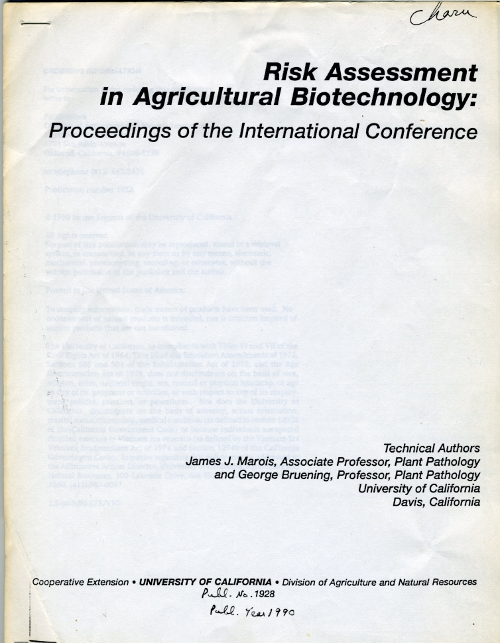
A major international conference scientific meeting titled "Risk Assessment in Agricultural Biotechnology" was held at the University of California, Davis.  It was sponsored by the College of Agriculture, The National Association of State Universities and Land Grant Colleges, and the USDA.  It included presentations by eminent scientists from around the world and covered a wide range of topics including potential effects on non-target organisms, potential health effects, ecological risks, and the potential for "gene flow" for various crops.  There was extensive discussion of how to best regulate this technology, and what monitoring methods were appropriate.  There was also a discussion of potential impacts on community function in agricultural areas.  Finally there was an analysis of how risk assessment affects public perceptions of biotechnology. If you are reading this now, chances are you just missed it - by more than two decades!
I was fortunate to be able to attend this event and was reminded of it the other day when I found a copy of the proceedings while clearing out some old paper files (remember those?, see yellowed document below).

This conference was held in August of 1988 - nearly twenty four years ago!   The meeting was held was eight years before any "biotech traits" were commercialized in Agriculture.  Even at that time, these topics had already been under consideration for a long time.  I first became aware of these discussions at Stanford in 1977 - 35 years ago.

This Does Not Fit With Widespread, False Narratives About This Technology

The reason a bring up this meeting is that I often hear or read assertions that plant biotechnology was something that was abruptly introduced without precautionary review.  Nothing could be further from the truth.  I'd be surprised if there has ever been a technology that received this much scrutiny from a broad range of independent experts (most of the people at the 1988 event were from academia, not industry).  Some say there is insufficient regulation of the technology, but in fact regulators at the USDA, EPA and FDA spent years figuring out what aspects of the technology each would regulate. That was a major topic of discussion at the 1988 meeting, and there were many other opportunities for public input.

Roads Not Taken

Looking back at the program from the 1988 meeting I was reminded that this risk assessment process was far from a rubber stamp.  There were several ideas that were never pursued commercially because the risks were deemed to be too significant.  For instance, it was decided that genetically engineered microbes should not be introduced live into the environment.  It was decided that GMO crops should not be introduced into areas where there have weedy relatives (e.g. sunflowers in the Midwestern US). There was the idea of improving the amino acid balance of corn (which is low in lysine) by incorporating the gene for the lysine-rich seed storage protein from Brazil nut.  Once the gene for the protein was isolated and expressed in a lab microbe, it was possible to test to see if that was the reason some people are allergic to Brazil nuts.  It turned out that it was the allergen, so the project was discontinued at that very early stage.  Some of the early examples of plant genetic engineering were done using something called the "gene gun."  That method often lead to insertions of multiple copies of the gene and so virtually all the work shifted over to the Agrobacterium vector approach - an organism from nature that is good at inserting single copies of genes into plant cells.
Sixteen years and billions of acres into the biotech crop revolution, it seems that the prior years of risk assessment have paid off.

You are welcome to comment here and/or email me at savage.sd@gmail.com